Core concepts
This section explains what ARK is, how it is designed, and why key decisions were made.
What is ARK?
ARK is a platform designed to provide reliable, production-grade infrastructure for AI agents and multi-agent systems. The key features of ARK include:
- Platform-agnostic agent operations.
- Standardized deployment patterns.
- Transparent orchestration.
- Built-in evaluation capabilities.
- Extensible tool integration.
- Multi-agent coordination.
- Custom headers support (e.g., request tracing, custom metadata).
ARK architecture
The reason ARK uses Kubernetes as its foundation is to build upon battle-tested orchestration patterns for distributed systems. Review the following guides to learn more:
- How ARK resources relate to and interact with each other.
- How query execution flows through the system.
- How the ARK gateway enables external access.
- How services work together.
- How workflows coordinate agent interactions.
- How observability provides system transparency.
Platform architecture concepts
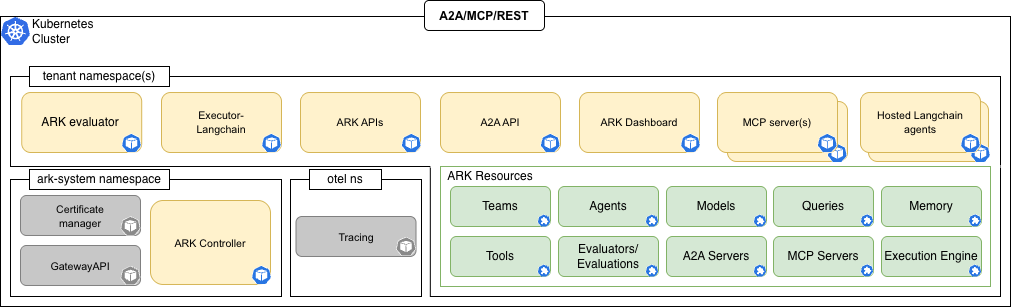
Core resources
ARK’s core resources represent the fundamental abstractions for building agentic systems. These resources follow Kubernetes patterns, making them familiar to platform engineers while providing specialized capabilities for AI workloads:
- Models: Configure and connect to AI models.
- Agents: Create autonomous AI agents with specific capabilities and tools.
- Teams: Orchestrate multiple agents working together with coordination strategies.
- Queries: Execute prompts and manage conversations with agents or teams.
- Tools: Define custom tools and MCP tool references for agents.
- MCPServers: Configure Model Context Protocol servers for external integrations.
- Memory: Persistent storage for agent conversations and state.
- Evaluator: Services for assessing and scoring agent performance.
- Evaluation: Define evaluation configurations and results.
- ExecutionEngine: Specialized runtimes for different agent frameworks.
- A2AServer: Agent-to-agent communication services.
MCP servers
Model Context Protocol (MCP) servers provide standardized interfaces for external tool integrations:
- filesystem-mcp: File system operations and management.
Services
ARK includes supporting services that extend the platform’s capabilities:
- ark-api: REST API for managing ARK resources (includes A2A Gateway for agent-to-agent communication).
- ark-dashboard: Web-based management interface.
- ark-mcp: MCP server integration service.
- ark-evaluator: Holistic evaluation and scoring service.
- localhost-gateway: Local development gateway (only on local).
- ark-broker: Memory storage with streaming support.
Marketplace services
Optional services are available from the Ark Marketplace :
- langfuse: Observability and tracing service.
- executor-langchain: LangChain agent execution engine.
Design effective agentic systems
The design of effective agentic systems requires understanding both technical patterns and practical constraints:
Extensibility concepts
ARK’s extensibility model allows customization while maintaining system stability. The platform provides extension points through:
Security and identity concepts
Security in ARK is built on Kubernetes RBAC and service account patterns, providing isolation and access control: